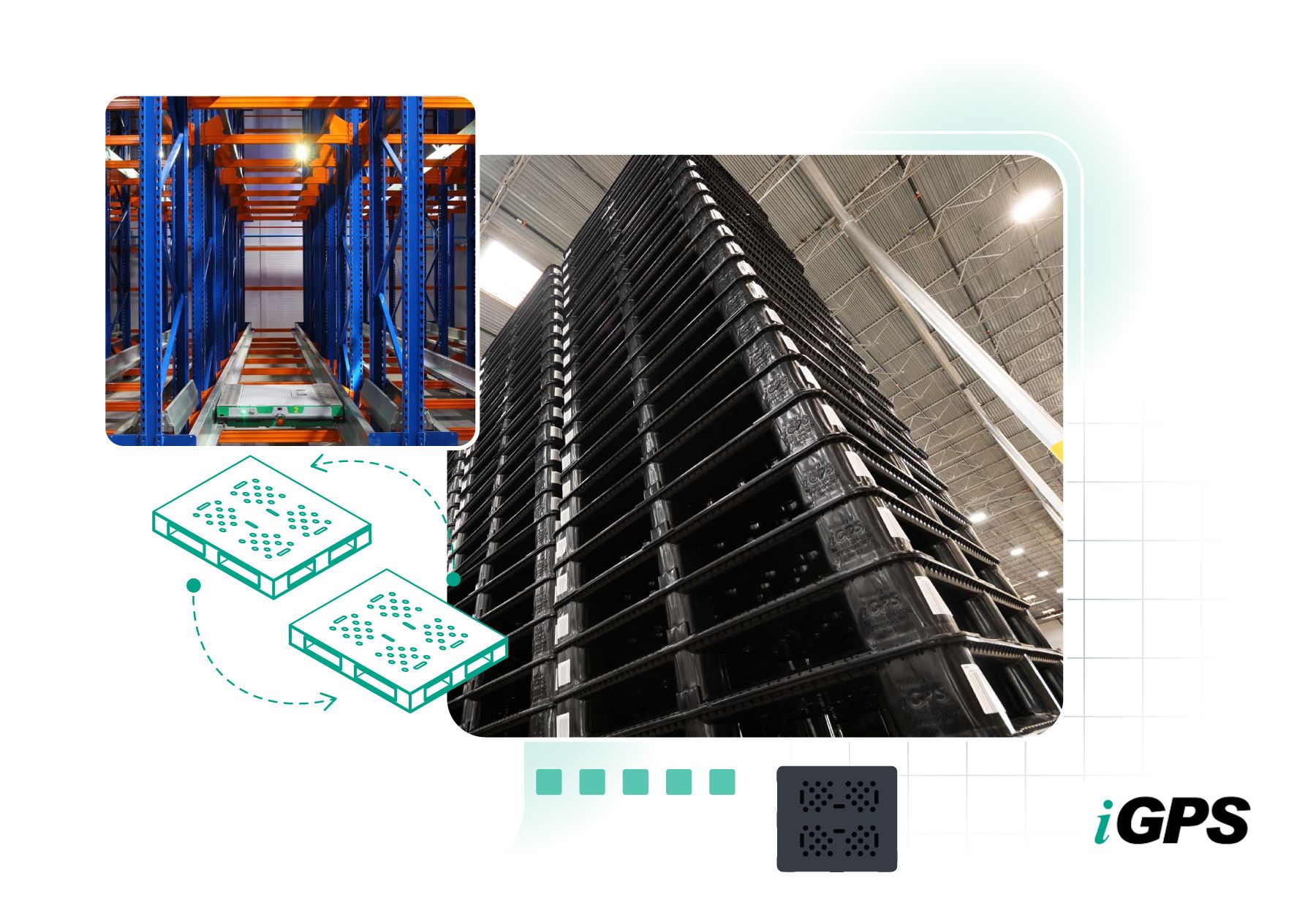
Key Takeaways
- Proper pallet organization cuts bottlenecks, forklift travel, and floor congestion.
- Many space and flow problems start with damaged or mismatched pallets.
- Standardized pallets improve stacking stability and usable storage space.
- Cleaner aisles reduce trip hazards, debris, and equipment strain.
- Warehouses run smoother when pallet supply stays consistent through pooling.
Effective pallet organization and warehouse flow are foundational to modern supply chain performance. As order volumes rise and distribution networks grow more complex, warehouses must optimize how pallets are staged, stacked, and moved in order to stay competitive. Efficient pallet organization improves space utilization, reduces forklift travel time, minimizes congestion, and creates predictable flow from receiving through outbound.
Benefits of Proper Pallet Organization
Proper pallet organization raises throughput and strips out hidden labor waste. Many daily delays stem from misplaced pallets, blocked travel paths, and unstable stacks that disrupt warehouse flow.
Common pain points include:
- Receiving congestion that slows unloading
- Forklift bottlenecks caused by unclear travel lanes
- Underused rack space from uneven pallet sizing
- Double-handling due to poor staging
- Unstable stacks that increase injury risk
According to Occupational Safety and Health Administration (OSHA), struck-by and caught-between incidents remain among the most serious warehouse hazards. This hazard is often driven by poor pallet stacking, congested aisles, and uncontrolled forklift traffic.
When organization improves, warehouses gain:
- Faster handoffs between shifts
- Better use of floor and vertical space
- Lower product damage and shrink
- More predictable staging and fewer pick-path disruptions
- Cleaner aisles with fewer safety flags
Basic Principles for Organizing Pallets in Your Warehouse
Effective pallet organization relies on predictable patterns—not complicated systems. These core principles work in warehouses of any size:
- Define clear pallet zones: Receiving, staging, outbound, returns, and empty pallet areas should be distinct and clearly labeled. Mixing these zones causes unnecessary congestion and delays.
- Keep aisles clean and pallets uniformly positioned: When pallets drift into travel lanes or sit skewed on the floor, forklifts slow down, and risks increase.
- Standardize stack heights: Consistent stack height improves stability and makes trailer loading faster. Variability adds safety hazards and slows operators.
- Prioritize first-move efficiency: Place fast-moving pallets closer to pick paths and reserve deep storage for slow movers.
- Reduce pallet variety where possible: Too many pallet types create slotting inefficiencies, unstable stacks, and unpredictable equipment handling.
These principles fail when pallet condition varies. Broken boards, warped platforms, and mixed sizes force operators to slow down and rebuild stacks. Uniform pallets allow organization systems to stay intact across shifts.
Smart Pallet Storage Hacks for Saving Space
Warehouse space carries daily cost. The fastest way to reclaim it is by tightening how pallets occupy the space already in use.
Practical tactics:
- Keep staging lines straight to prevent small gaps from compounding into lost square footage.
- Stop pallet drift beyond marked lanes to protect travel paths.
- Face pallets in the direction of their next move to reduce congestion.
- Combine partial stacks to recover vertical capacity.
- Remove damaged pallets before they fracture stack patterns.
- Control empty pallet volume so staging zones stay open.
These tactics depend on consistent pallet dimensions. When pallet sizes vary, stacks lean, rack fit suffers, and space fragments.
How To Choose the Right Pallet Storage Solution
While this post does not focus on racking types, choosing the right pallet storage system is essential for pallet organization.
Prioritize systems that support:
- Consistent stacking patterns: Irregular pallet footprints, even by a quarter inch, reduce usable rack space and cause jams.
- Smooth, predictable pallet flow: Storage should support traffic patterns, not interrupt them.
- Fast access and minimal double-handling: Every unnecessary touch adds cost and slows operations.
- Compatibility with automation: Even partial automation (conveyors, sensors, pallet shuttles) requires uniform pallet dimensions.
Warehouses often find their organization issues result from incompatible pallets rather than poor layouts. Even minor size variation limits clean stacking and disrupts flow.
How Plastic Pallets Help Optimize Storage Space
Consistent pallets strengthen every organization system.
Why plastic performs well:
- Uniform dimensions support straight stacks and tighter slotting.
- No broken boards keeps aisles clear and prevents pallet debris.
- Lower weight improves staging speed and reduces strain.
- Flat surfaces keep stacks square inside marked lanes.
- RFID compatibility supports faster identification and pallet counts.
Where pallet pooling supports organization gaps:
- Standard pallets every delivery create predictable stack height
- Empty pallets leave before they create staging blockages
- Repairs stay off site so damaged pallets do not reenter flow
- Tracking simplifies counts and slotting control
Good warehouse organization comes from clean flow, stable stacks, and open travel lanes. Pallet quality determines how well those systems hold together across shifts.
Standardized pallets fit racks without waste, reduce aisle clutter, and move through staging without constant rework. When pallet repairs, sorting, and empty return management disappear from daily tasks, layouts stay intact and labor stays focused.
Pallet pooling ensures those pallets arrive in consistent condition every time. That stability allows organization strategies to operate at full speed.
FAQ
What is the best way to organize pallets?
The best way to organize pallets is to keep them visible, accessible, and consistent across all zones. Assign fixed areas for staging, overflow, and ready-for-use pallets so platforms do not drift into aisles.
Stack pallets by type and condition to prevent unstable piles. Use floor markings and signage to reduce double-handling. Standardized pallets make stacking and slotting easier and keep pallet zones from breaking down across shifts.
What is the ideal warehouse layout?
The ideal warehouse layout is one that reduces travel time, minimizes congestion, and supports smooth pallet flow from receiving to shipping. In practice, that means:
- A clear, linear path for goods: receiving → storage → picking → staging → outbound.
- Wide, unobstructed aisles that allow safe two-way forklift movement.
- Well-defined pallet zones (empty pallet storage, staging, overstock, returns) to prevent clutter.
- High-velocity items placed closest to staging, reducing travel and bottlenecks.
- Consistent pallet quality, since uniform pallets stack predictably and help maintain clean, efficient lanes.
Rather than a one-size-fits-all blueprint, the best layout is one that supports fast movement, easy visibility, and predictable pallet handling in order to improve safety, accuracy, and daily productivity.
How to stack pallets in a warehouse?
Pallets should be stacked in a way that maximizes space without compromising safety or stability. General best practices include:
- Stack like with like — same pallet type, size, and condition to prevent leaning or uneven loads.
- Use flat, level ground and avoid stacking near high-traffic aisles or fire exits.
- Follow height limits (usually 4–6 pallets high, depending on pallet strength and load weight).
- Keep stacks straight and centered to maintain balance and prevent tip-overs.
- Inspect pallets before stacking — damaged or broken wood pallets weaken the entire stack.
- Use standardized plastic pallets when possible — consistent dimensions make stacks more stable and predictable.
Proper pallet stacking reduces aisle congestion, improves forklift efficiency, and lowers the risk of injuries or product damage.
What is the stacking limit of pallets?
There’s no single universal stacking limit, it depends on pallet type, load weight, and warehouse safety rules. However, most operations follow these guidelines:
- Check manufacturer ratings: Plastic pallets often support more consistent stacking heights than wood, which can weaken or vary in strength.
- Typical safe range: Many warehouses stack 4–6 pallets high, but only when loads are stable and evenly distributed.
- Never exceed weight limits: Each pallet has a maximum static load capacity, and exceeding it increases the risk of collapse.
- Keep pallet types uniform: Mixing wood and plastic or combining damaged pallets reduces stack integrity.
- Follow OSHA and site-specific policies: Some facilities restrict stacks to lower heights based on aisle width, traffic, or product sensitivity.
Using standardized, structurally consistent pallets, such as high-quality plastic pallets, helps maintain predictable stacking limits and improves overall warehouse safety.
What are the OSHA rules for pallet storage?
OSHA does not provide one single rule for pallet storage, but several standards outline how pallets must be handled and stacked to prevent injuries, fires, and tip-overs. Key requirements include:
- Stable, secure stacking: Pallets must be stacked so they cannot slide, collapse, or fall (OSHA 1910.176(b)).
- Clear aisles and exits: Pallet storage cannot block emergency exits, fire equipment, electrical panels, or forklift pathways.
- Flat, even surfaces: Stacks must sit on level flooring and remain even, no leaning or irregular piles.
- Remove damaged pallets: Pallets with broken boards, protruding nails, or structural defects must be taken out of service.
- Fire-code compliance: Local fire authorities may set pallet stack height limits based on material type and storage configuration, including plastic pallet volumes in enclosed areas.
- Safe forklift handling: Operators must be trained to place and retrieve pallets safely without creating unstable stacks (OSHA 1910.178).
Overall, OSHA’s expectation is that pallets are stored in a stable, hazard-free manner that protects workers and keeps emergency pathways fully accessible.
What is OSHA’s 3 most cited violation?
According to recent national OSHA enforcement summaries, the three most frequently cited workplace safety violations include:
Fall Protection (29 CFR 1926.501)
This remains the most cited OSHA violation nationwide. It includes missing guardrails, unprotected edges, and improper use of safety harnesses.
Hazard Communication (29 CFR 1910.1200)
According to independent safety analysis published by ICW Group, Hazard Communication, a violation that covers failures to properly label chemicals, maintain Safety Data Sheets (SDS), and train employees on chemical hazards, consistently ranks second.
Ladders (29 CFR 1926.1053)
Improper ladder use, damaged ladders, and incorrect climbing practices round out the top three.
These three standards account for a large share of OSHA enforcement actions each year. They directly affect warehouse, distribution, and storage operations where pallet handling, elevated storage, and worker access happen every day.
Companies working to improve how pallets are staged, stacked, and moved rely on standardized pallets from iGPS. Consistent sizing, durable construction, and RFID visibility support cleaner layouts and faster pallet flow across every zone. For more information, call 1-800-884-0225, email a specialist at switch@igps.net, or visit the contact page to learn how iGPS supports better warehouse organization.