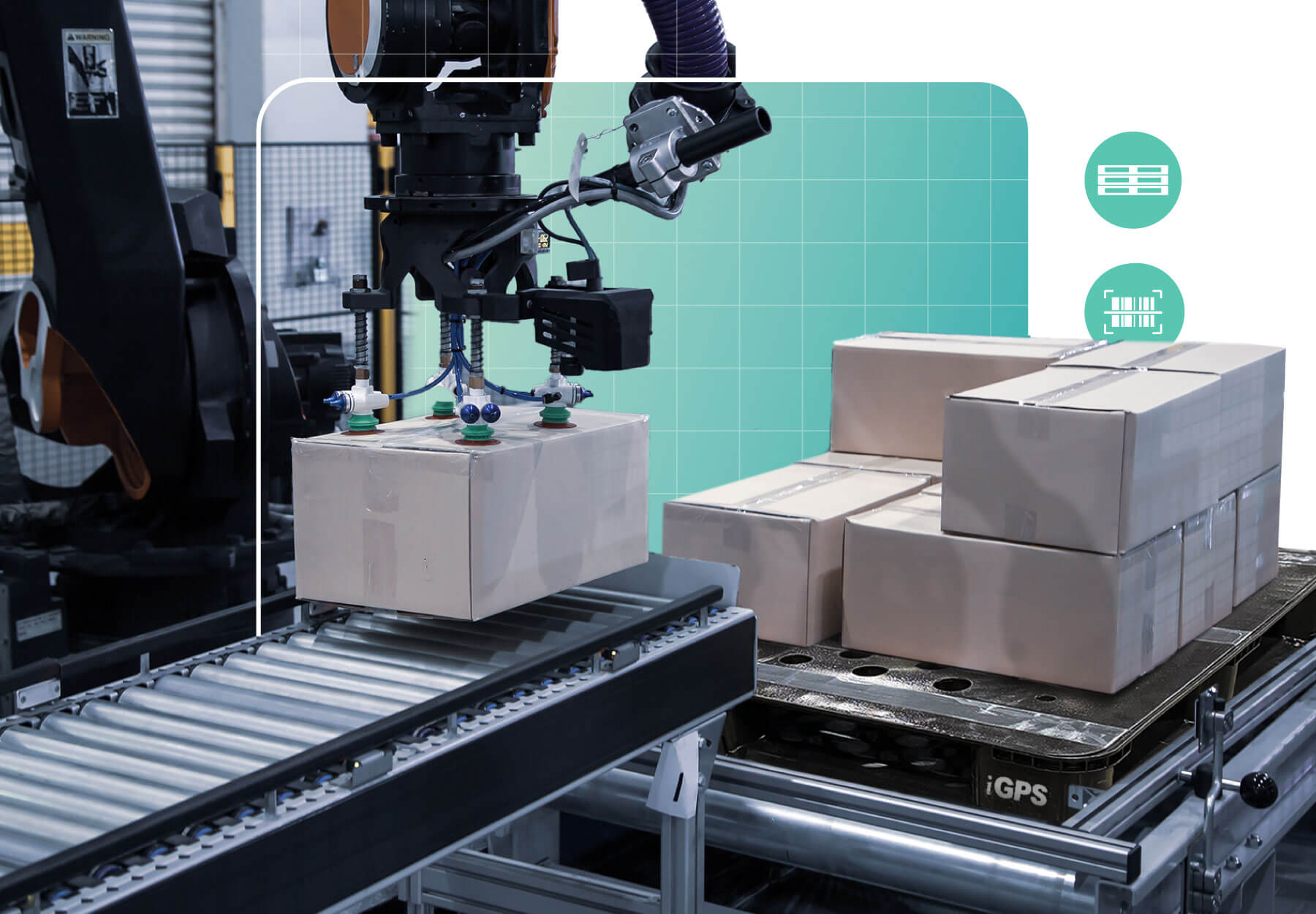
Pallet turnover rate in high-volume distribution measures how often pallets complete a full cycle—and it’s one of the clearest indicators of flow inside a warehouse.
High-volume distribution centers don’t struggle with pallet supply as much as they struggle with pallet flow.
Pallets are usually in the network. The issue is how long they sit, where they stall, and how often they actually complete a full cycle. When turnover slows, it shows up quickly—more pallets on hand, more space consumed, and more capital tied up in inventory and assets that aren’t moving.
Improving pallet turnover rate is a practical way to tighten warehouse operations without adding labor or expanding footprint. It connects directly to how you manage inventory, how quickly product moves, and how efficiently your network runs.
Key Takeaways:
- Pallet turnover rate measures how often pallets complete a full cycle through your operation, and it directly reflects flow, not just supply
- Low turnover is usually caused by dwell time, recovery delays, inconsistent pallet performance, or poor tracking—not a lack of pallets
- High-volume distribution depends on consistent pallet movement to control warehouse space, labor efficiency, and capital tied up in inventory
- Plastic pallets and pooling improve turnover by reducing damage, standardizing dimensions, and removing recovery and repair bottlenecks
- Improving turnover comes down to tightening visibility, reducing idle time, and aligning pallet supply with actual throughput demand
What Is Pallet Turnover Rate
Pallet turnover rate measures how often a pallet completes a full operational cycle within a defined period.
That cycle typically includes receiving, storage, picking, staging, outbound shipment, and eventual return or reuse. In high-volume environments, the goal is to keep that cycle moving without interruption.
It aligns closely with inventory turnover. Inventory turnover ratio measures how many times inventory is sold and replaced, while pallet turnover reflects how efficiently the platform supporting that inventory moves through the same system.
When turnover is high, pallets are supporting throughput. When it drops, they are sitting somewhere in the network.
How to Calculate Pallet Turnover Rate
The formula is straightforward. The challenge is defining the inputs consistently across your operation.
Pallet Turnover Rate = Total Pallet Cycles ÷ Average Pallet Inventory
| Component | How to Define It | Common Mistake |
|---|---|---|
| Total pallet cycles | Completed movements through receiving, storage, and outbound over a set period | Counting partial moves or using inconsistent timeframes |
| Average pallet inventory | Pallets actively available for use in the operation | Including excess inventory or pallets sitting outside normal flow |
| Turnover rate | Total cycles divided by average inventory | Inflated inventory lowering perceived performance |
In practice, most issues come from how average inventory is defined. When idle or offsite pallets are included, turnover rate drops on paper even if flow has not changed.
Example: Pallet Turnover Rate
- Total pallet cycles (per week): 500
- Average pallet inventory: 250
Pallet Turnover Rate = 500 ÷ 250 = 2.0
Each pallet completes two full cycles per week. That indicates steady movement with limited dwell time.
If average pallet inventory increases to 400 while cycles stay the same:
500 ÷ 400 = 1.25
Throughput is unchanged, but turnover drops. More pallets are sitting idle in the system, which typically points to longer dwell time, recovery delays, or excess inventory being carried.
Inventory Turnover Ratio (for comparison)
Inventory turnover follows the same logic but applies to product instead of pallets.
Inventory Turnover Ratio = Cost of Goods Sold ÷ Average Inventory
| Component | How to Define It | Common Mistake |
|---|---|---|
| Cost of goods sold (COGS) | Total cost of product sold during the period | Using revenue instead of cost |
| Average inventory | Beginning inventory + ending inventory ÷ 2 | Including obsolete inventory or overstated stock levels |
| Turnover ratio | COGS divided by average inventory | Inflated inventory lowering the ratio |
Example: Inventory Turnover Ratio
- Cost of goods sold: $1,000,000
- Average inventory value: $250,000
Inventory Turnover Ratio = $1,000,000 ÷ $250,000 = 4.0
Inventory is sold and replaced four times during the period.
If average inventory increases to $400,000 without a change in sales:
$1,000,000 ÷ $400,000 = 2.5
The ratio drops, even though demand is unchanged. More capital is tied up in inventory, and inventory efficiency declines.
Pallet Turnover vs. Pallet Dwell Time: Two Sides of the Same KPI
Turnover and dwell time describe the same behavior from different directions.
Turnover tells you how often pallets move. Dwell time shows how long they stay still.
In practice, dwell time is where most issues surface. Pallets wait on docks, sit in trailers, or remain staged longer than expected. Those delays reduce how many times pallets complete a cycle in a week or month.
Operations that maintain higher turnover usually have tighter control over staging, faster load-out, and fewer handoffs where pallets can get stuck.
What Slows Down Pallet Turnover in High-Volume Distribution?
In most operations, pallets don’t stop moving because of one issue. Turnover slows when small inefficiencies stack up across handling, tracking, and recovery.
What looks like a supply problem is usually a flow problem. Pallets are in the network, but they are sitting longer than they should—on docks, in trailers, or staged between processes.
The result is predictable: higher average inventory, more warehouse space consumed, and more capital tied up without improving throughput.
According to the U.S. Energy Information Administration, diesel prices remain elevated compared to pre-2020 levels, which continues to put pressure on transportation costs. In that environment, improving asset efficiency—including pallet turnover—becomes a direct lever for controlling cost across the network.
Pallet Damage and Unplanned Downtime
Damage rarely shows up as a single event. It builds over time.
Boards loosen, decks crack, and units fail inspection. When that happens, pallets get pulled from circulation mid-process or during inbound checks. Each removal creates a gap that has to be filled, often with additional handling or substitution.
In high turnover environments, even a modest damage rate can reduce available capacity. The result is slower flow and more pallets required to maintain the same throughput.
Plastic pallets provide more consistent structure across repeated cycles. They do not splinter or shed debris, which reduces how often pallets are removed from use.
Inefficient Pallet Recovery and Reverse Logistics
Recovery is one of the least visible constraints in pallet turnover.
Once pallets leave your facility, they move outside your control. They may sit at retail locations, in back rooms, or in trailers waiting for pickup. Coordinating return requires time, transportation, and labor.
Delays in that loop increase dwell time and force operations to carry more pallets than needed for actual throughput. That increases warehouse space usage and inventory carrying costs.
Inconsistent Pallet Specifications Disrupting Automation
Variation creates friction inside automated systems.
Pallets that vary in size, weight, or condition can cause misalignment, sensor faults, and load instability. Those issues slow down conveyors and require manual intervention.
Over time, this gets treated as normal equipment behavior. In reality, it’s often tied to inconsistent inputs.
Plastic pallets provide consistent dimensions and do not warp or absorb moisture. That stability helps maintain throughput and supports consistent turnover across automated systems.
Manual Pallet Tracking and Inventory Blind Spots
Many operations still rely on manual tracking or periodic counts to manage pallet inventory.
That approach creates gaps. Pallets may be recorded as available but are staged elsewhere or sitting at downstream locations. This is where phantom inventory starts to build.
Without accurate inventory tracking, teams compensate by carrying excess inventory. That increases storage requirements and makes it harder to manage inventory levels effectively.
How Industrial Plastic Pallet Pooling Improves Pallet Turnover Rate
Improving turnover requires reducing friction at every point in the pallet lifecycle—movement, tracking, recovery, and reuse.
Pallet pooling changes how pallets move through the network. Instead of managing inventory, repair, and retrieval internally, the system is designed to keep pallets in circulation with consistent quality and availability.
That shift removes delays that slow down turnover and replaces them with a more predictable flow across facilities.
Recent supply chain coverage in Forbes highlights a broader shift from speed to efficiency and cost control. Pallet turnover sits directly in that shift, reflecting how well assets move through the system, not just how fast they move once.
Consistent, Damage-Resistant Pallets Stay in Rotation Longer
Turnover improves when pallets stay in circulation.
Plastic pallets are built for repeated use. They maintain their shape, resist moisture, and avoid the wear patterns that lead to frequent removal. Fewer pallets are pulled out for repair or disposal.
That keeps more units available to support daily throughput and reduces the need to carry backup inventory.
RFID Tracking Eliminates Phantom Inventory
Visibility changes how inventory is managed.
Pallets with embedded RFID tags generate data at defined scan points. Each scan records pallet ID, location, and movement history. This creates a clear picture of how pallets move through the network.
It does not detect pallet condition, but it does show where delays occur and where pallets last moved. That information helps reduce loss, improve inventory tracking, and maintain better control over inventory levels.
The Depot Network Removes Recovery Lag from the Turnover Cycle
Most delays in turnover come from recovery, not outbound movement.
In owned systems, pallets leave with shipments and remain offsite until someone arranges pickup. That delay extends the cycle and forces operations to carry more inventory to compensate.
Pooling shifts that responsibility to a managed network. The provider handles retrieval, inspection, and redistribution through regional depots.
Pallets move back into circulation without relying on internal coordination, which shortens the cycle and keeps turnover aligned with actual flow.
Uniform Dimensions Maximize Automation Throughput
Automation performance depends on consistency.
When pallets vary, systems slow down. Loads shift, sensors misread, and operators step in to correct issues. These interruptions reduce throughput and extend cycle time.
Plastic pallets maintain consistent dimensions and smooth surfaces. Equipment runs at expected speeds, and pallets move through without disruption. That stability supports higher turnover across the operation.
On-Demand Pallet Supply Supports Peak Periods Without Spot Buys
Peak demand puts pressure on pallet availability.
Owned systems typically respond in two ways. Teams either carry excess inventory year-round or rely on spot buys when volume increases. Both approaches increase cost and complexity.
Pooling provides access to pallets when needed. Supply increases during peak periods and adjusts downward when demand stabilizes.
This keeps inventory levels aligned with actual throughput and avoids tying up capital in unused pallets.
5 Steps to Building a Pallet Turnover Improvement Plan
Improving turnover starts with identifying where pallets stop moving and why. Most issues show up in a few consistent areas.
| Step | What to Review | What Good Looks Like (KPI Signal) | Operational Impact |
|---|---|---|---|
| 1. Audit inventory and dwell time | Where pallets sit across receiving, storage, staging, and outbound | Dwell time stays low and consistent across zones; pallets move within expected cycle windows (e.g., same-shift or next-day movement) | Reduces idle time, frees up warehouse space, and increases overall turnover rate |
| 2. Identify damage and loss rates | Frequency of pallets removed from circulation due to damage or loss | Low removal rate relative to total pallet volume; minimal need for replacement or buffer inventory | Maintains available pallet supply and avoids carrying excess inventory to offset loss |
| 3. Evaluate tracking visibility | How pallet movement is captured (manual vs. scan-based systems) | High scan compliance at key process points; minimal “unknown location” inventory | Improves inventory tracking accuracy and reduces phantom inventory that slows turnover |
| 4. Assess automation compatibility | How pallets perform in conveyors, AS/RS, and handling systems | Minimal equipment stops tied to pallet issues; stable flow with no recurring manual intervention | Increases throughput and keeps pallets moving through the system without delay |
| 5. Consider pallet pooling | Time and effort spent on retrieval, repair, storage, and repositioning | Short recovery cycle time with consistent pallet availability; no buildup of offsite or idle inventory | Removes recovery lag, stabilizes supply, and aligns pallet availability with actual throughput |
Conclusion
Pallet turnover rate is a simple metric, but it reflects how well your operation actually moves.
In high-volume distribution, improving turnover is not about adding more pallets. It’s about reducing the time pallets spend sitting still. That means tightening dwell time, improving visibility, and removing friction in recovery and reuse.
Operations that improve turnover tend to see the same outcomes: less space tied up in idle inventory, fewer disruptions in handling, and more consistent throughput across the network.
The most effective changes come from standardization and control. Consistent pallet performance, reliable tracking, and a managed pooling system keep pallets moving instead of waiting.
As cost pressure continues across transportation, labor, and inventory, turnover becomes more than a KPI—it becomes a control point for how efficiently the entire operation runs.
When pallets stay in motion, the rest of the operation follows.
FAQs
What is pallet turnover rate in distribution?
Pallet turnover rate measures how often pallets complete a full cycle through a distribution operation over a set period. It reflects how efficiently pallets support warehouse operations and overall supply chain flow.
What is a good pallet turnover rate for a distribution center?
A good turnover rate depends on volume, network complexity, and dwell time. High-volume facilities aim for higher turnover, where pallets move quickly and spend minimal time idle.
How does pallet damage affect turnover rate?
Damage removes pallets from circulation and reduces available supply. This increases dwell time, slows flow, and often requires additional inventory to maintain throughput.
What is pallet dwell time and how does it relate to turnover?
Dwell time is the amount of time a pallet remains idle within the network. As dwell time increases, turnover rate decreases because pallets complete fewer cycles.
How does RFID tracking improve pallet turnover rate?
RFID tracking provides visibility into pallet movement at scan points. It captures location and movement history, which helps reduce loss, improve inventory tracking, and support better operational decisions.
Why do high-volume distribution centers need consistent pallet dimensions?
Consistent dimensions support reliable automation performance. Variation can cause equipment disruptions, reduce throughput, and increase manual intervention.
How does a pallet pooling program improve pallet availability during peak seasons?
Pooling provides access to a shared pallet network. Operations can increase supply during peak demand and reduce it afterward without purchasing or storing excess inventory.
Operations that need tighter control over pallet turnover can move to the iGPS pooled plastic pallet system. These pallets are consistent, durable, and RFID-enabled, helping reduce dwell time, improve visibility, and keep pallets in circulation without the burden of retrieval or repair. The result is less idle inventory, better use of warehouse space, and more predictable flow across the network. For more information, contact us at 1-800-884-0225 email a specialist at switch@igps.net, or visit our contact page.